
Frequently Asked Questions
Who is Kinfolk Hunting Collective For?
Kinfolk Hunting Collective is for everyone (18 and older) who feels a connection to the outdoors but may have felt unwelcome or unsure where to start. We are a community built on mentorship, safety, and a shared love for the land.
While our programs are open to all who share our values, we are passionate about creating a space where BIPOC, Queer folks, and Women feel a true sense of belonging. We're here for anyone ready to connect with their food, become a steward of the land, and find their people. Here, you’re not a guest. You’re kin
How many events do you do in a year?
Our programming for this year consists of:
3-5 deer hunts
1 turkey hunt
1 waterfowl hunt
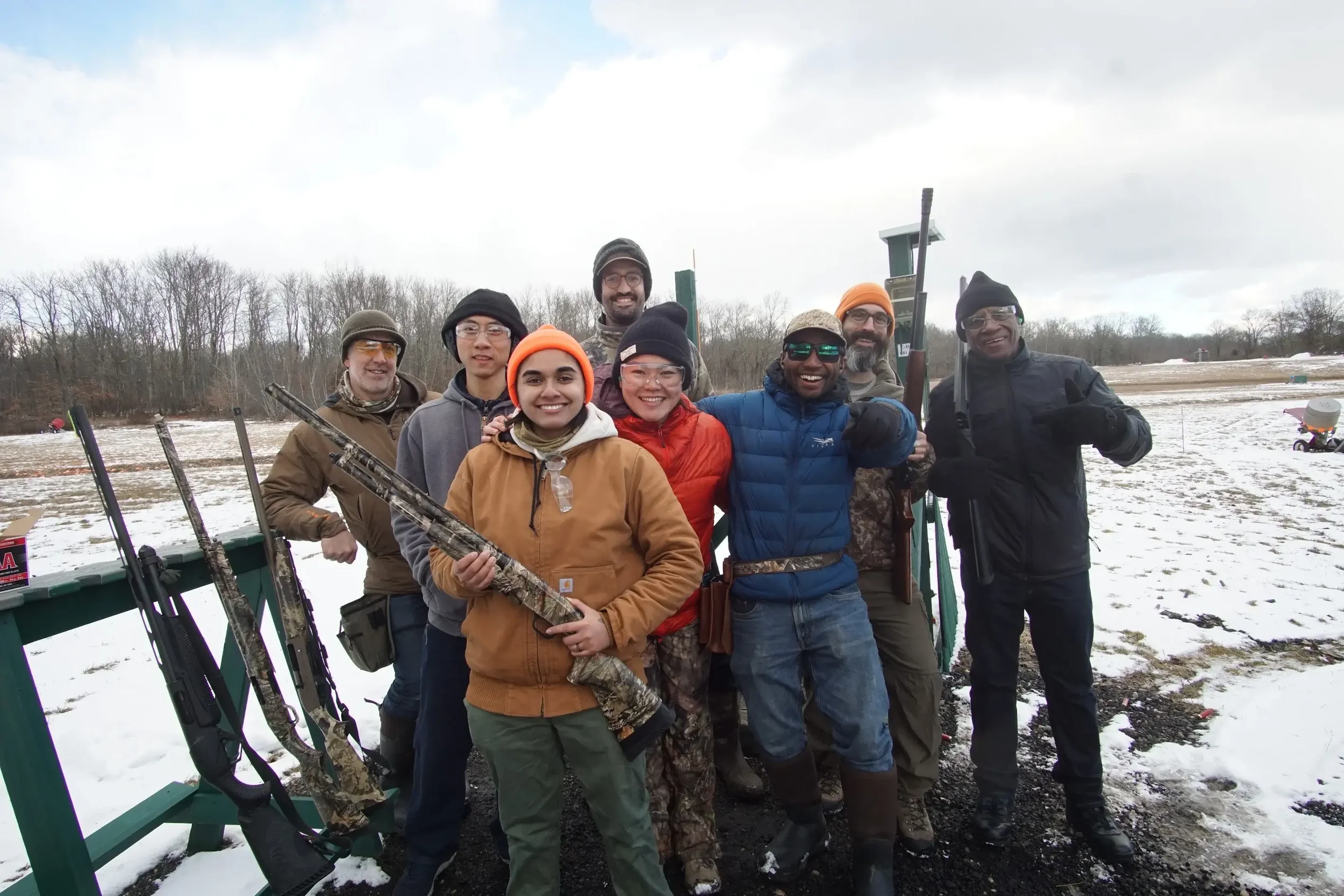
Other smaller educational events such as woods skills, archery, scouting, shotgun shooting and more
We are adding more events every year!
How do the hunts work?
All of our hunting events run from noon on Friday to mid-afternoon on Sunday. Our hunts pair up to 10 mentees one on one with an experience mentor who will be their hunting partner, coach and teacher for the weekend. In addition to actually hunting, we also add additional programming meant to teach hunting skills to mentees. This includes:
talks by biologists about the species we are hunting
hands on field dressing, processing, and butchering
additional training with the weapon being used whether it is archery equipment or firearms
tree stand use and safety
basic scouting and hunting skills
gear
We spend time ensuring everyone gets to know one another. We are not just trying to teach folks to hunt but also working to create a new community! Many of our mentees and mentors end up hunting together after these events!
Where do your events take place?
All of our events are New York based, primarily downstate (south of Albany) and Long Island. All of our hunts take place on private land we have access to through multiple land conservancy partners. If you have access to private land and would like to collaborate with us to host a hunt, please reach out! We are hoping to expand to more locations in the state.
How much does this cost?
Most events are free to mentees though we have a suggested optional donation that we use to fund future events and gear.
How do I get to the event if I don’t have a car?
We encourage mentees and mentors to carpool where possible and facilitate that conversation prior to the event.
What about other outdoor activities like fishing/camping/etc?
We are adding more programming and most definitely want to add more events focused on the outdoors. We are planning on new events focused on fishing, foraging, scouting, map reading, camping and more. Keep an eye on our upcoming events page!
Do I have to provide my own gear?
For the most part we have gear for mentees to use. We expect mentees to have good base layers appropriate to the weather we will be experiencing. For any mentee selected, we will communicate with them if anything else is needed prior to the event, but in most cases, we provide almost everything needed.
Where are we staying for these hunts?
It depends on the hunt. For our warmer weather hunts such as the Turkey Camp, we are camping out in tents. For other hunts, we are staying indoors either in a facility available to us on the property or in a nearby Airbnb.
Can I borrow gear to hunt on my own after I attend one of the hunts?
In most cases, the answer is YES! We want our community to hunt together and support each other as much as possible. We have gear we can loan out to prior mentees and most all of our mentors also offer to take people out hunting and loan gear as needed. We want you to become lifelong hunters and that is not something that happens in one weekend
What are we eating?
We eat well at these events. We do our best to eat wild game for at least one meal at our events and have served wild venison, duck, squirrel, and bear! We provide food, snacks and drink for everyone for the entire weekend for free. We take into account any dietary restrictions and will offer alternatives.
We also set aside some of the venison from our hunts to provide food for the next event!
Do I have to use a firearm if I am uncomfortable doing so?
No you don’t. Most of our hunts are going to be using a crossbow. We do have firearm hunts, but those are obviously optional to apply for
Can I bring my child to the event?
No, unfortunately, Kinfolk Hunting Collective events are restricted to attendees 18 and older.
How do I stay involved after being a mentee?
Most of our hunts we will leave room for past mentees to come and hunt on their own. They are part of our hunt camp but are not paired with a mentor. Our hope is that eventually prior mentees will graduate to become mentors and help to teach the new generation of mentees. We are already seeing that happen!
Do I need a hunting license?
You do not need a hunting license to join our community, however, to participate in any of our events that include hunting, the answer is yes you will. As a precursor, all mentees who want to hunt will need to take both the Hunter Education Course and the Bowhunter Education Course. If you apply and are selected to attend one of our hunts, you will need to purchase/print out any necessary NY hunting licenses/tags. This will all be made clear to mentees prior to the event. For any fishing events, you will need a NY fishing license.
What is Kinfolk Hunting’s stance on any proposed sale of venison?
We oppose any legislative or regulatory changes that would allow for the commercial sale of wild-harvested venison in New York State. While we understand the desire to find new tools for deer population management, we believe the commercialization of wild game presents significant risks to conservation efforts and the ethical foundations of our community.
Our opposition is based on two primary pillars:
1. Preservation of the North American Model of Wildlife Conservation The North American Model is the world's most successful system of wildlife management, and its success is built upon the elimination of markets for game.
Historical Context: In the 19th century, unregulated market hunting led to the near-extinction of many species, including white-tailed deer. The current model was created specifically to end this exploitation, moving away from commercial profit and toward a system that relies on science-based management and regulated recreational hunting to keep wildlife populations healthy and balanced.
The Public Trust Doctrine: This principle dictates that wildlife belongs to all people and is managed by the state for the public good. Once a price tag is placed on a wild animal, it ceases to be a shared resource and becomes a commodity. This shift creates financial incentives that historically lead to over-exploitation and poaching.
2. Wildlife as Kin, Not a Commodity At Kinfolk Hunting, our definition of community includes the land and the animals that sustain us. We believe that placing a monetary value on wildlife fundamentally alters the relationship between the hunter and the harvest.
Community Stewardship: Hunting is a practice of self-sufficiency and stewardship. Sharing the harvest with family, friends, and those in food-insecure households is a cornerstone of hunting culture that reinforces community bonds.
Ethical Integrity: When wildlife has a market value, the pressure to "produce" for profit can compromise the ethics of fair chase. We believe the focus should remain on the shared experience and the respect for the animal, rather than a financial transaction.
We advocate for managing deer populations through expanded access for ethical, recreational hunters—specifically those from underrepresented communities—rather than through the creation of commercial markets. We must protect the principle that wild game is a gift of the land to be shared, not a product to be sold.
What is Kinfolk Hunting’s stance on the use of lead ammunition?
We strongly encourage the use of non-toxic (lead-free) ammunition for all hunting activities. We believe that moving away from lead is a vital step in protecting the health of our ecosystems, the wildlife that inhabits them, and the communities that rely on wild game for food.
Our position is guided by three primary considerations:
1. Stewardship of the Land and Wildlife As stewards of the outdoors, we recognize the impact that lead fragments can have on the environment.
Impact on Scavengers: Lead left in the field—whether in gut piles or unrecovered game—poses a significant threat to non-target species. Scavengers, most notably bald eagles and other raptors, are highly susceptible to lead poisoning from even small fragments.
Ecosystem Health: Reducing lead input into the environment is a proactive measure to ensure the long-term health of the landscapes we hunt.
2. Food Safety and Quality Hunting is a primary source of clean, sustainable food.
Non-toxic ammunition, such as copper or bismuth, does not fragment in the same way as lead. Using non-toxic alternatives ensures that the meat we provide for our families and community is free from lead contamination.
Public health experts agree there is no safe amount of lead to ingest. Studies have shown that individuals who consume wild game harvested with lead ammunition often have significantly higher levels of lead in their blood than those who do not.
3. Reducing Barriers and Ensuring Access While we advocate for non-toxic alternatives, KHC is opposed to an outright legislative ban on lead ammunition. However, we remain open to collaborative approaches that would phase out lead use over time, provided such plans include robust mechanisms to reduce the cost of non-toxic alternatives.
We recognize that non-toxic ammunition is often more expensive and can be difficult to find in certain calibers. For many new hunters and those from marginalized communities, these costs can represent a significant barrier to entry.
Rather than support mandates that may exclude hunters, we support efforts to lower the cost and increase the availability of non-toxic options.
Kinfolk Hunting Collective will work to ensure that all of our community-led hunts and mentored programs utilize non-toxic ammunition. We are committed to educating our members on the performance benefits of non-toxic loads and helping our mentees navigate the transition to lead-free hunting.
Missed something?
If you have questions not answered here, please feel free to reach out to us at faq@kinfolkhunting.org and we will get back to you with an answer.